
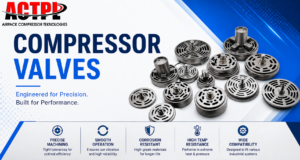
Introduction:
Valves are critical components in reciprocating compressors, directly governing gas flow, pressure control, and overall system efficiency. Their design and selection have a significant impact on performance, reliability, and operating costs.
Understanding the different types of reciprocating compressor valves is essential for industries where compressors operate under demanding conditions. The right valve configuration ensures optimal flow dynamics, minimizes energy losses, and enhances service life.
For businesses in Delhi and across industrial sectors, investing in high-quality compressor valves is key to improving efficiency, reducing downtime, and preventing premature wear. This guide provides a comprehensive overview of the various valve types used in reciprocating compressors and their industrial applications.
What Are Reciprocating Compressor Valves?
Reciprocating compressor valves are precision-engineered mechanical components that regulate the flow of gas into and out of the compression chamber. They operate automatically based on pressure differentials—opening when upstream pressure exceeds downstream pressure and closing to prevent reverse flow.
These valves play a critical role in maintaining compression efficiency, sealing integrity, and overall compressor performance. Their design ensures minimal pressure drop, quick response, and reliable operation under varying load and process conditions.
Types of Reciprocating Compressor Valves
- 1. Suction Valves
Suction valves control the intake of air or gas into the cylinder during the suction stroke. They open automatically when the cylinder pressure drops below the inlet (or atmospheric) pressure, allowing gas to enter. As soon as compression begins and internal pressure rises, the valves close to prevent backflow. - Discharge Valves
Discharge valves regulate the release of compressed gas from the cylinder to the discharge line or storage system. They open when the cylinder pressure exceeds the downstream pressure and close immediately after discharge to ensure proper sealing and avoid reverse flow. - Concentric Valves
Concentric valves consist of multiple ring-shaped flow passages arranged concentrically, providing a larger effective flow area with minimal resistance. This design enables smoother gas flow, lower pressure drop, and improved efficiency, making them ideal for high-capacity and high-performance compressor applications. - Reed Valves
Reed valves use thin, flexible metallic strips that deflect under pressure differential to allow flow. Their simple construction makes them cost-effective and easy to maintain. However, in heavy-duty or high-temperature applications, reeds tend to fatigue and wear faster, limiting their service life. - Non-Return (Check) Valves
Non-return valves, or check valves, ensure unidirectional flow by allowing gas to pass in one direction while preventing backflow. They are essential for protecting the compressor and maintaining system pressure stability. - Poppet Valves
Poppet valves feature a disc or conical element that moves axially to open and close the flow path. They provide excellent sealing performance and are well-suited for high-pressure and demanding operating conditions due to their robust design. - Unloader Valves
Unloader valves are designed to relieve or reduce compressor load during startup and shutdown. By temporarily bypassing or venting pressure, they minimize motor load, reduce starting torque, and improve overall energy efficiency and operational reliability. - Ring Valves
Ring valves consist of multiple annular rings that lift and reseat during operation. They offer high flow capacity, robust construction, and reliable performance, making them widely used in heavy-duty and high-capacity industrial compressors. - Valve Plates
Valve plates are thin, precision components that control gas flow by opening and closing against the valve seat. Their design and surface finish are critical for ensuring proper sealing, minimal leakage, and efficient compressor performance. - Metallic Valves
Metallic valves are manufactured from high-strength materials such as stainless steel or alloy steels. They provide excellent durability, high temperature resistance, and mechanical strength, making them suitable for demanding and high-pressure industrial applications. - Thermoplastic Valves
Thermoplastic valves are made from advanced polymer materials such as PEEK or nylon-based compounds. They offer excellent corrosion resistance, low weight, and reduced noise operation, making them ideal for applications requiring chemical resistance and smoother performance.
Importance of Choosing the Right Valve Type
Selecting the correct valve type is critical to achieving optimal performance and long-term reliability in a reciprocating compressor. Valve design directly influences flow dynamics, pressure losses, and overall system efficiency.
The right valve selection ensures:
- Optimized gas flow with minimal pressure drop, improving volumetric efficiency
- Enhanced durability and operational reliability, even under demanding conditions
- Lower maintenance and lifecycle costs, due to reduced wear and failures
- Improved energy efficiency, leading to significant cost savings over time
- Consistent and stable compressor performance, minimizing downtime and disruptions
In industrial applications, an incorrect valve choice can lead to energy losses, frequent breakdowns, and reduced equipment life—making proper selection a key engineering decision.
Applications of Different Valve Types
Reciprocating compressor valves are deployed across a wide range of industries, with selection driven by operating pressure, temperature, gas composition, and duty cycle.
They are commonly used in:
- Manufacturing and production industries – for compressed air systems, automation, and process operations
- Automotive service and workshops – for air tools, painting systems, and maintenance applications
- Oil & Gas industry – for gas compression, transmission, and processing under high-pressure conditions
- Chemical and petrochemical plants – where corrosion resistance and material compatibility are critical
- Power plants – for fuel gas handling, air systems, and auxiliary compression duties
Each application demands a specific valve design—metallic, thermoplastic, ring, plate, or poppet—based on process parameters such as pressure, temperature, gas properties, and required service life. Proper selection ensures safe, efficient, and reliable compressor operation.
Why Quality Matters in Compressor Valves.
High-quality compressor valves are fundamental to ensuring long-term reliability, consistent performance, and minimal risk of mechanical failure. Since valves operate under continuous cyclic loading, pressure variations, and temperature fluctuations, their material integrity and manufacturing precision directly impact compressor life.
Premium-quality valves offer:
- Superior sealing and reduced leakage, improving overall efficiency
- Longer service life, even under high-pressure and high-temperature conditions
- Resistance to wear, fatigue, and corrosion, especially in demanding applications
- Reduced unplanned downtime, leading to better operational continuity
- Lower total cost of ownership, through fewer replacements and repairs
Manufacturers in Delhi and other industrial hubs focus on precision machining, advanced materials (such as alloy steels and high-performance thermoplastics), and stringent quality control processes. This ensures that each valve meets tight tolerances, surface finish requirements, and performance standards essential for reliable compressor operation.
Conclusion
Understanding the different types of reciprocating compressor valves is essential for maximizing the efficiency, reliability, and performance of compressor systems. From suction and discharge valves to metallic and thermoplastic designs, each type serves a specific function in ensuring smooth and effective operation.
Selecting the right valve based on your application requirements—such as pressure, temperature, and gas composition—helps optimize performance, reduce energy losses, and extend equipment life. A well-informed choice not only enhances operational efficiency but also delivers significant cost savings over the long term.